
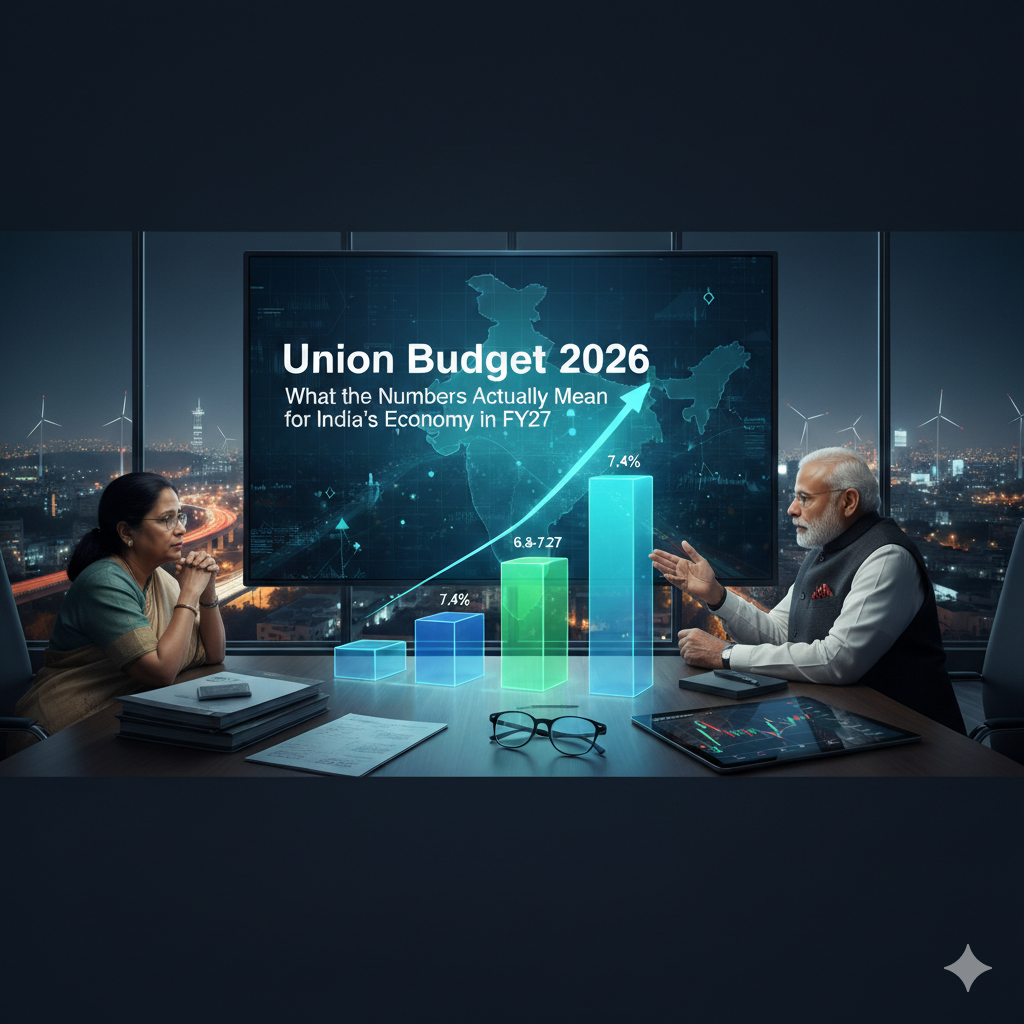
Union Budget 2026: What the Numbers Actually Mean for India's Economy in FY27
By PrincipaCore & SwaptheMarkets| January 2026 Reading Time: 12 minutes
India's Union Budget 2026–27 arrives at a moment most analysts are calling "normalisation." After an exceptional FY26 where GDP touched 7.4%, the economy is slowing—not crashing. Growth is expected to moderate to 6.8–7.2% in FY27, foreign investors are pulling money out, and the rupee is under pressure.
So what does this Budget actually do about it?
The short answer: nothing flashy. And that's exactly the point.
Here's what the numbers behind Budget 2026 actually reveal.
The Context: Why FY26 Was a One-Time High
Before understanding the Budget, you need to understand what made FY26 exceptional—and why that combination won't repeat.
FY26 was a rare convergence of tailwinds. Personal income tax cuts put money directly into middle-class pockets. RBI cut interest rates by 125 basis points after inflation collapsed to historic lows—CPI touched 0.3% in Q1 FY26, a number almost no major economy has seen in modern history. GST rationalisation brought down prices on essentials. And favorable base effects from a weaker FY25 made year-on-year comparisons look impressive.
For context on India's broader economic trajectory heading into FY27, read our analysis on India's Economic Outlook FY26
Each of these individually would have boosted growth. Together, they created a "Goldilocks moment" that won't repeat in FY27. Tax cuts deliver maximum impact in year one, then normalize. Rate cuts are done—inflation is expected to rise back to 3.9% by Q1 FY27, and core inflation remains sticky near 4.6%. Base effects reverse.
This isn't a crisis. It's a return to India's natural growth rate. The real question Budget 2026 must answer is: how does India sustain 6.8–7.2% growth without relying on one-time boosts?
The answer lies in where the government chooses to spend.
Capital Expenditure: The Only Number That Matters
If there's one number to watch in Budget 2026, it's capital expenditure.
Capex is government spending on long-term assets—roads, railways, ports, defence equipment, power infrastructure. Unlike consumption stimulus (tax cuts, subsidies), capex creates compounding returns. A highway built today generates economic activity for decades. A defence platform commissioned today keeps India secure for 20 years while simultaneously building domestic manufacturing capability.
Budget 2026 is expected to allocate ₹12–12.5 lakh crore in capex for FY27—a 10–14% increase over FY26, maintaining roughly 3.1–3.2% of GDP. This isn't a dramatic jump. It's a deliberate continuation of the multi-year capex push that began post-Covid.
The critical detail isn't the total number. It's where the money goes.
Defence and allied industries are the clear priority. Defence capex could jump from ₹1.8 lakh crore in FY26 to ₹2.5–3 lakh crore in FY27—a potential 40–60% increase. This isn't driven by budget politics. It's driven by strategic reality. Post-Operation Sindoor, India's armed forces have identified critical shortfalls in equipment and capability. The government has responded by shifting from "spending more" to "spending smarter"—prioritising indigenous manufacturing, long-range modernisation programs like the P-75I submarine program and fighter aircraft upgrades, and reducing import dependence.
Infrastructure spending—roads, railways, ports—continues at a steady pace, though not at the aggressive levels of FY24–25. Railways will see targeted investment in safety systems and decongestion rather than new route expansion.
Infrastructure/Real Estate → Link to:
- "Infrastructure development is creating wealth in real estate, with 15% annual returns. Read our analysis: Infrastructure Boom Drives 15% Return."
Renewable energy and grid infrastructure remain priorities, supporting the green transition without sacrificing fiscal discipline.
The message from the capex allocation is clear: India is investing in assets that compound over decades, not in stimulus that fades in one year.Solar panels and wind turbines are copper-intensive, contributing to rising renewable energy costs despite cheaper panels. Full analysis: "Renewable Energy Costs Rising" (Jan 22)
Fiscal Discipline: The Real Story Behind the Headlines
The fiscal deficit target for FY27 is expected to land between 4.1–4.3% of GDP—down from 4.4% in FY26. On the surface, this looks like a modest improvement. But the context makes it significant.
India's fiscal deficit peaked at 9.2% of GDP during Covid. The government has brought it down steadily without slashing public investment. That's a difficult balancing act, and international rating agencies are watching.
The long-term goal—reaching roughly 50% debt-to-GDP by FY31—is a credibility signal to the world. It tells foreign investors that India isn't going to inflate its way out of problems or borrow recklessly to chase growth. In a global environment where the US is running deficits above 6% of GDP and several emerging markets are facing debt crises, India's fiscal trajectory stands out.
There is a real constraint here, though. Interest payments now consume approximately 37% of net government revenue. This limits how much the government can spend on new programs or tax relief without compromising the deficit path. It's the reason Budget 2026 focuses on precision over populism—every rupee of spending must justify itself.
One important shift: the government is moving from monitoring "fiscal deficit as a percentage of GDP" to targeting "debt as a percentage of GDP" from FY27 onward. This subtle change gives slightly more flexibility in annual spending while keeping the long-term balance sheet under control.
The External Pressures No Budget Can Solve
Budget 2026 cannot control US tariff policy. It cannot prevent FPI outflows or stabilise oil prices. But it can reduce the damage these pressures cause—and that's what it's attempting to do.
US tariffs of 50% on certain Indian exports remain in place, and trade negotiations are delayed. Exporters face real uncertainty in order planning. FPIs pulled ₹41,280 crore out of India in January 2026 alone, and the rupee touched ₹91.96 per dollar—making it one of the weakest currencies in Asia despite India being the fastest-growing major economy.
The Budget's response to these pressures is indirect but deliberate. By maintaining fiscal discipline and signalling policy stability, it reduces the risk premium that foreign investors attach to Indian assets. A credible deficit path keeps bond yields in check. Stable taxation removes the unpredictability that causes capital flight.
None of this will reverse FPI outflows overnight. But it creates the conditions where, once global risk appetite returns, India is the first destination capital flows into—not the last.
What This Means for Markets and Sectors
Budget 2026 is unlikely to trigger euphoria. It's not designed to. What it should deliver—if executed well—is a quiet re-rating of India's risk profile.
Defence is the obvious beneficiary. The capex increase creates multi-year order visibility for companies across the supply chain—from large PSUs like BEL and HAL to smaller manufacturers in electronics, precision engineering, and shipbuilding. Infrastructure plays a steady role: cement, steel, capital goods, and logistics companies benefit from sustained government spending without needing dramatic allocation increases.
Renewable energy and power infrastructure benefit from continued green transition investment. The grid expansion needed to support both renewable capacity and rising EV adoption requires sustained capital allocation—something Budget 2026 appears to deliver.
"EV adoption will be slower than expected, creating opportunities in hybrids and premium ICE: Why Only 15% Will Go Electric."
Consumption-heavy sectors may underperform in the near term. Without fresh tax cuts or demand stimulus, consumer spending growth will depend on wage increases and rural recovery rather than policy-driven boosts. This doesn't mean consumption stalls—it means it normalises.
The market reaction will likely follow the execution, not the announcement. Investors have seen enough budgets to know that allocations on paper don't automatically translate to spending on the ground. The real test is whether capex disbursement in H1 FY27 matches the targets—and whether defence procurement timelines accelerate.
The Bottom Line
Budget 2026 is not designed to make India grow faster. It's designed to make India grow sustainably.
In a world where governments are competing to inflate growth numbers through stimulus, India is choosing a different path—one built on fiscal credibility, long-term capital investment, and strategic self-reliance. This isn't exciting. It won't generate the headlines that tax cuts or spending splurges do.
But in today's global environment, credibility may be the most valuable asset an economy can have. And that's exactly what Budget 2026 is building.
[Link: For context on India's broader economic trajectory heading into FY27, read our analysis on India's Economic Outlook FY26]
[Link: The defence capex push connects directly to India's manufacturing transformation—covered in our report on India's $1 Trillion Digital Economy]
Disclaimer: This is educational content for research purposes only. Not investment advice. Consult a SEBI-registered advisor before making financial decisions.
Sources: RBI, Ministry of Finance, Motilal Oswal Budget Preview, JM Financial, Morgan Stanley, Business Standard, Economic Survey 2025-26