
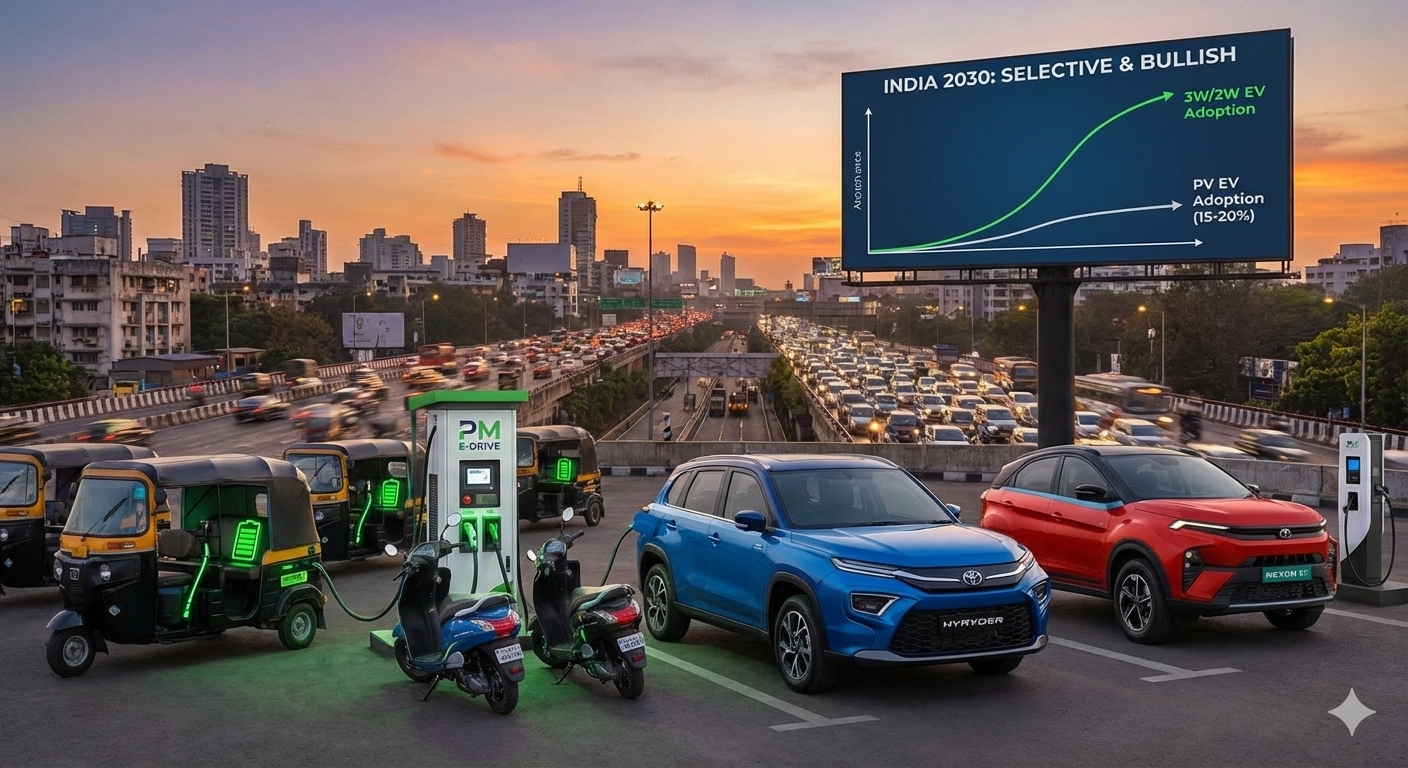
EV Adoption India 2030 — Why Only 15% of Cars Will Go Electric (And That's Bullish)
Title: EV Adoption India 2030: Why Realistic Penetration is 15-20%,Not 100%
Description: EV adoption varies by segment. 3Ws: 75% EV. 2Ws: 65% EV. But passenger vehicles? Only 15-20%. Here's why—and how to profit from it.
Target Keywords: EV adoption India 2030, electric vehicles realistic, hybrid vs EV, Indian auto sector EV, realistic EV penetration
Reading Time: 9 minutes
The Thesis in 30 Seconds
| MetricReality | |
| Volumes | Flat to +2% (FY25) |
| Inventory | 80-85 days (discount-driven) |
| Value Growth | Strong (SUV mix + features) |
| Structural Trend | Hatchbacks declining permanently |
"For investors looking to capitalize on this transition, we've identified key stocks in our Auto Sector Investment Watchlist."
The investment consensus on EVs is wrong.
Everyone predicts "massive EV adoption by 2030." The reality is far more nuanced—and that nuance is where smart money profits.
Here's the truth:
- Three-wheelers: 70-80% EV (already happening)
- Two-wheelers: 60-70% EV (economic advantage is clear)
- Passenger vehicles: Only 15-20% EV (cost + infrastructure gaps remain)
- Commercial vehicles: Selective, niche adoption (long-haul needs diesel)
The real winners aren't pure EV companies. They're hybrid-focused OEMs and component suppliers building the bridge technology while battery costs plummet.
The EV Penetration Reality: Segment-by-Segment Truth
Two-Wheelers: EVs Will Dominate (60-70% by 2030)
Why?
Economics make it mandatory, not optional.
A ₹70,000 EV scooter vs. a ₹55,000 ICE scooter:
| ComponentCostEVICE | |||
| Purchase Price | — | ₹70,000 | ₹55,000 |
| Fuel Cost (3 years) | — | ₹0 | ₹15,000 |
| Servicing (3 years) | — | ₹2,000 | ₹5,000 |
| Total Cost of Ownership | 3 years | ₹72,000 | ₹75,000 |
Net result: Buying the EV is actually cheaper.
When economics are this clear, adoption isn't a "prediction"—it's an inevitability.
Winners: Hero MotoCorp, Bajaj, TVS (scooter EV dominance)
Disruption level: Moderate (no subsidy needed; payback = 2-3 years)
Three-Wheelers: EVs Already Won (70-80% by 2030)
This is the silent EV success story that nobody talks about.
Auto-rickshaw drivers in Delhi, Bangalore, Mumbai are already switching to EVs because:
- Daily usage pattern is perfect for EVs: 100-150 km/day = ideal EV range
- Fuel cost advantage is massive: 150% savings vs. CNG
- Zero subsidy needed: Payback in 2-3 years from fuel savings alone
- Fleet buyers adopt fastest: Uber, Rapido, logistics companies buy in bulk
Reality Check (2025): EVs already command 40-50% of 3W sales in metros. This segment is past the adoption curve—no longer a "future trend," but a present reality.
Investment angle:
Bajaj Auto's auto-rickshaw EV unit is printing money. Mahindra's 3W electrification is its most profitable division. Component suppliers like Sona BLW are making EV drivetrains for this segment globally.
Winners: Bajaj Auto, Mahindra (3W EV leadership)
Disruption level: Complete (ICE will be dead in 3W by 2030)
Passenger Vehicles: The Realistic Ceiling is 15-20% by 2030
This is where consensus completely breaks down.
Everyone says: "EVs will dominate by 2030."
Reality says: "Nope. Only 15-20%."
Reason 1: Battery Cost Economics Still Don't Work
Here's the brutal math:
| ComponentICE SUVEV SUV | ||
| Engine + Transmission | ₹1.5L | — |
| Battery (60 kWh) | — | ₹4.5L |
| Motor + Inverter | — | ₹1.5L |
| Chassis + Body | ₹3L | ₹3L |
| Electronics + Interior | ₹3.5L | ₹3.5L |
| Manufacturing | ₹2L | ₹2L |
| Total Cost | ~₹8-9L | ~₹13-14L |
"The premiumisation trend driving profitability is analyzed in The Premiumisation Shift Rewriting Auto Valuations."
The reality:
A Mahindra XUV700 ICE SUV costs ₹12L.
A Mahindra XUV400 EV (the EV equivalent) costs ₹15L+.
A buyer choosing between:
- Mahindra XUV700 ICE: ₹12L, proven reliability, strong resale
- Mahindra XUV400 EV: ₹15L, unproven battery life, uncertain resale
Chooses the ICE. Every time.
Even with the ₹1.5L subsidy (which the government removed), the EV is still ₹3.5L more expensive.
The harsh truth: Battery costs haven't fallen enough to make EVs cost-competitive with ICE for the average Indian buyer. They won't be till 2028-2030.
Reason 2: Range Anxiety & Charging Infrastructure Are Real Barriers
Delhi has ~2,000 public EV charging stations for ~50,000 electric vehicles.
Math: 25 EVs per station.
Compare to petrol: ~30,000 petrol pumps for 400,000+ cars.
Math: 13 cars per pump.
EV charging infrastructure is 2x underdensified vs. petrol. Building 60,000+ charging stations nationwide will take 5-7 years.
Until then, EV adoption is limited to:
- Urban metro dwellers with home charging
- Corporate fleet buyers with dedicated chargers
- Tech enthusiasts willing to tolerate range anxiety
Rural India? Zero EV adoption till 2030. No charging, no affordability.
Reason 3: Financing & Resale Confidence Gaps
Banks are hesitant to finance expensive EVs when resale values are uncertain.
Current lending reality:
| Vehicle TypeLTV RatioDown Payment on ₹15L Car | ||
| ICE SUV | 80% | ₹3L |
| EV SUV | 60% | ₹6L |
A ₹15L EV requires ₹6L down payment. A ₹12L ICE requires ₹2.4L down.
The ICE car is 2.5x more financeable.
Most middle-class Indian buyers don't have ₹6L sitting in savings. They need financing. EVs don't make financial sense for them.
Reason 4: Resale Uncertainty is a Real Deterrent
A 5-year-old ₹12L ICE SUV still sells for ₹6-7L. Resale value is predictable.
A 5-year-old ₹15L EV SUV? Nobody knows.
Uncertainties:
- Battery degradation after 5 years (how much range loss?)
- Tech obsolescence (is a 2025 battery management system outdated by 2030?)
- Charging infrastructure—will it be ubiquitous, or still sparse?
Result: Buyers panic. Banks don't lend aggressively. OEMs can't move volume.
Commercial Vehicles: Selective, Niche Adoption
M&HCV (trucks, buses) will remain 95% diesel by 2030 because:
- Long-range needs (500+ km daily) demand diesel fuel economics
- Battery weight penalty kills payload (critical for cargo trucks)
- Charging logistics nightmare for commercial operators
Exception: Urban last-mile logistics (e-commerce parcel delivery). EVs will dominate here. But this is <5% of CV market.
The Hybrid Strategy: The Real Winner's Play
Here's what smart OEMs (Toyota, Mahindra, Maruti) are doing:
Don't fight EV adoption. Bridge it with hybrids.
Why Hybrids Actually Win Till 2030:
| MetricICEHybridEV | |||
| Cost Premium vs. ICE | 0% | +15-20% | +35-50% |
| CAFE Compliance | ✗ | ✅ | ✅ |
| Fuel Savings | — | 30-40% | 100% |
| Resale Confidence | ✅ | ✅ | ❓ |
| Affordability for Masses | ✅ | ✅ | ✗ |
Result: A Toyota Innova Hycross (hybrid) costs ₹13L, saves 30% fuel, meets emissions, and has proven resale value.
A Tata Nexon EV costs ₹15L+, has range anxiety, and resale value is a question mark.
The winner? The hybrid, every single time.
The Counterintuitive PM E-DRIVE Win
When the government removed the ₹1.5L subsidy for private EV cars, the market tanked.
Consensus: "EV adoption just got killed."
Smart investors thought: "Actually, this is bullish long-term."
Why subsidy removal = long-term positive:
- Subsidy was subsidizing bad unit economics
- OEMs were selling loss-making EVs to hit volume targets. Removing subsidies forces them to build profitable models.
- Profitable adoption > Subsidy-dependent adoption
- Short-term: EV volumes drop 20%.
- Medium-term: Only viable EVs get built and sold.
- Long-term: EV business models are sustainable, not zombie companies.
- Smart capital allocation wins
- Tata Motors, which is already profitable in EVs, benefits. Subsidy-chasing startups (betting on government cheques) die.
Investment implication:
OEMs transitioning to profitable EV + hybrid blends (Tata, Mahindra) will outperform subsidy-dependent pure EV bets.
The PLI Tailwind: Why Component Suppliers Win Biggest
Government's PLI forces localization of high-value components:
- Electric motors & controllers (₹50,000+/vehicle)
- Battery systems & management (₹1-2L+/vehicle)
- ADAS sensors & processors (₹50,000-₹1.5L/vehicle)
- Software & OTA platforms (recurring revenue)
Why this matters for investors:
A ₹15L EV car is 40% battery/motor/electronics. That's ₹6L of content going to component suppliers, not OEMs.
Sona BLW (EV driveline maker) will sell to:
- Mahindra (100,000 EV units/year)
- Tata (80,000 EV units/year)
- Maruti (50,000 EV units/year)
- Global exports (200,000 units/year)
- Total: ₹1,000+ crores in annual revenue
PLI provides 4-6% margin boost on this revenue = ₹40-60 crores of free money.
Stock market insight: Auto ancillaries deserve 25-35x P/E because they're riding:
- EV adoption (rising demand)
- Export growth (China+1)
- Margin expansion (PLI)
- Lower cyclicality (multi-OEM, multi-geography)
OEMs sit at 15-20x. Ancillaries should be 25-35x. The market hasn't priced this in yet.
What to Avoid:
Pure EV startups (unsustainable unit economics)
"100% EV by 2030" companies (unrealistic margin promises)
Subsidy-dependent EV programs
Key Takeaway
EV adoption in India will be selective, not universal. And that's excellent for investors.
Companies that understand this nuance—building profitable hybrids today while scaling EVs tomorrow—will massively outperform the "all-in EV" bet.
Component suppliers capturing margin from the EV + hybrid transition will outperform OEMs stuck competing on volumes.
What's Next?
[Part 3 — Best Auto Stocks to Buy 2025: Stock Picks + Portfolio Strategy for 3-5x Returns]
In Part 3, we'll reveal exactly which stocks to buy, avoid, and how to allocate capital across conservative, balanced, and aggressive portfolios. We'll show you the specific valuations, price targets, and time horizons for each.
Subscribe for Weekly Deep-Dives
Get instant access to:
- Sector deep-dives backed by data
- DCF-based stock valuations
- Portfolio strategy frameworks
👉 Subscribe to SwapTheMarkets: swapthemarkets.substack.com
📸 Follow on Instagram: @SwapTheMarkets
Disclaimer: This article is for educational and informational purposes only. It is not investment advice. Please consult a SEBI-registered advisor before making investment decisions.