
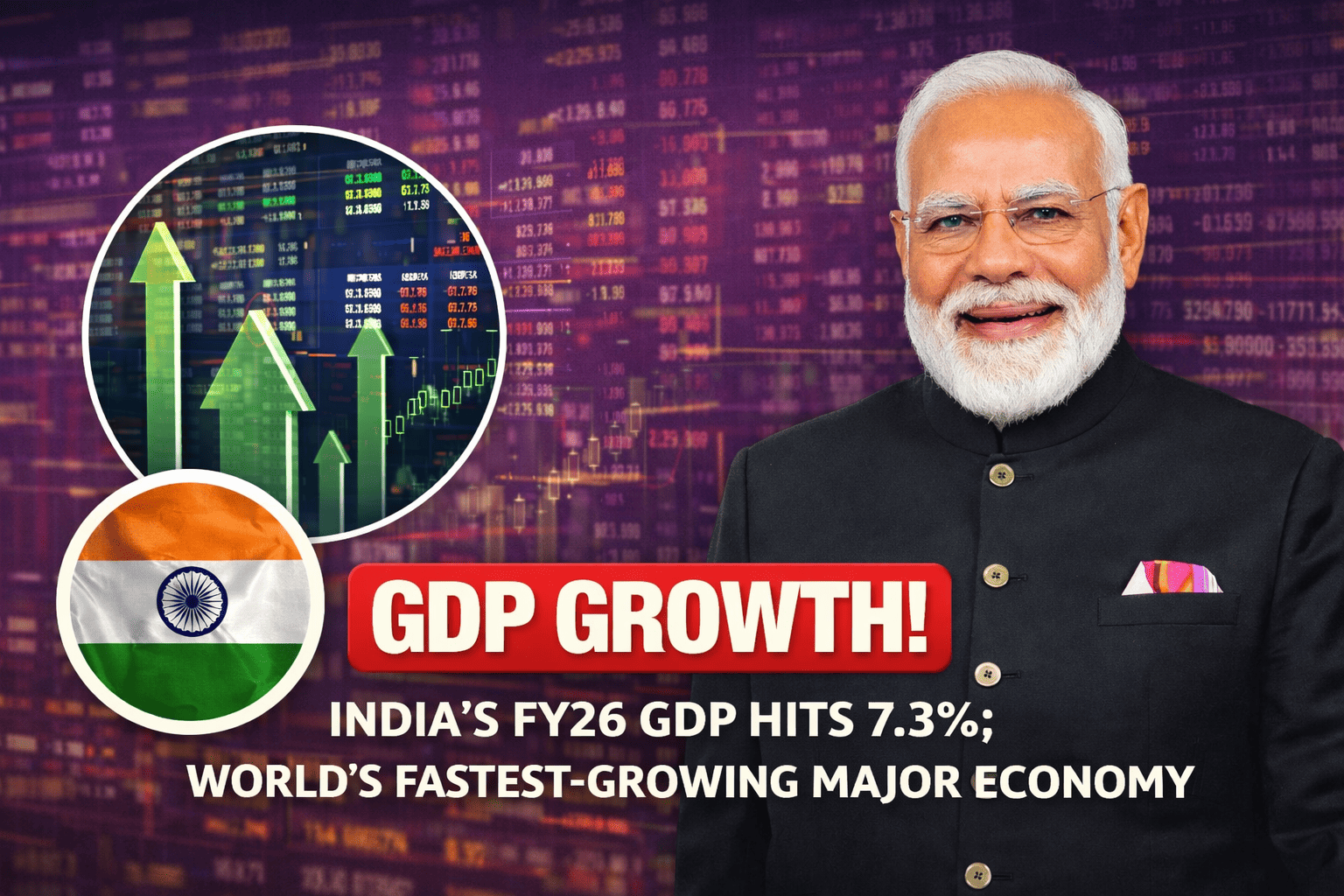
India's economy is growing at 7.3% in FY26—faster than China, the US, and Europe combined. But the real story isn't the speed. It's what happens next. Here's what You need to know about India's economic surge, job opportunities, and investment potential.
Reading Time: 10 minutes
Category: Indian Economy | Career Planning | Investment Strategy
By SwapTheMarkets Research | January 2026
Key Highlights
🚀 India's growing at 7.3%—the fastest major economy in the world
💰 Inflation at historic lows (1.33%)—rare "Goldilocks" moment
⚠️ Growth will slow to 6.4% by FY27—but that's actually healthy
📊 What's driving it: Tax cuts, manufacturing boom, AI services explosion
🎯 What matters for you: Job opportunities in tech, manufacturing, and services are surging
The bottom line: This isn't just another economic cycle. India's structural advantages—young population, tech dominance, manufacturing shift—position it for a decade of sustained growth. But FY26's boost is temporary. Understanding what's real vs what's hype matters for your career and money.
India Is Outpacing Everyone—And It's Not Even Close
Let's put this in perspective:
Global Growth Comparison (FY26):
- 🇮🇳 India: 7.3%
- 🇨🇳 China: 4.5%
- 🇺🇸 United States: 2.4%
- 🇪🇺 Europe: 1-1.5%
India isn't just winning. It's dominating.
While the rest of the world worries about recession, India is dealing with the "problem" of managing growth. This matters if you're:
✅ Planning your career (where jobs are being created)
✅ Investing money (where returns are highest)
✅ Starting a business (where demand is growing)
But here's the twist nobody's talking about: FY26's 7.3% isn't sustainable—and that's actually fine.
Infrastructure/Real Estate → Link to:
- "Infrastructure development is creating wealth in real estate, with 15% annual returns. Read our analysis: Infrastructure Boom Drives 15% Return."
The Rare Consensus: When Everyone Agrees, Pay Attention
Economic forecasts are usually all over the place. Not this time.
FY26 Growth Projections:
- IMF: 7.3%
- World Bank: 7.2%
- RBI: 7.3-7.4%
- Government (NSO): 7.4%
When the IMF, World Bank, RBI, and government all agree within 0.2%, that's not speculation—that's data-backed confidence.
But there's a catch: FY27 growth is expected to moderate to 6.4%.
This isn't bad news. It's normalization. And understanding why matters.
What's Actually Powering India's Growth Right Now?
1. 💸 Tax Cuts = More Money in Your Pocket
What happened:
- Income tax cuts for middle-income earners
- GST rate cuts on essentials (food, household items)
Real-world impact:
- Average middle-class family saved ₹15,000-₹30,000 annually
- People spent more → businesses earned more → economy grew
Why it matters to you: More disposable income = higher consumption = more job creation in retail, services, and hospitality.
2. 🏭 Manufacturing Is Finally Having Its Moment
For years, India talked about "Make in India." Now it's actually happening.
Production-Linked Incentive (PLI) Scheme:
- ₹2 lakh crore+ investments realized
- Electronics exports up 39%
- iPhone production in India: $22 billion in one year (Tata Electronics)
The Apple Effect: Apple isn't just "testing" India. It's moving ALL U.S.-bound iPhone production from China to India by end of 2026.
What this means for Gen-Z:
- 34,000+ direct manufacturing jobs created
- 100,000+ indirect jobs (suppliers, logistics, retail)
- High-paying roles in electronics, semiconductors, and auto manufacturing
3. 🤖 AI Services: India's Next $100B+ Opportunity
While everyone talks about AI replacing jobs, India is making money from AI.
Current AI Services Revenue (Q3 FY26):
- TCS: $1.8B annualized (17.3% growth QoQ)
- HCL Tech: 19.9% growth QoQ
- GenAI automation: 44% of routine coding tasks
India isn't competing with AI. It's building, deploying, and selling AI globally.
Career implication: If you're in tech, AI skills = premium salaries. If you're not in tech, AI-adjacent roles (data labeling, prompt engineering, AI content) are booming.
4. 🌾 Rural India Is Back (And That's Huge)
Rural India = 40% of India's workforce. For years, it lagged. Now it's recovering.
Why?
- Good monsoons = strong agricultural output
- Rising rural wages
- Government welfare programs
Why this matters: When rural India earns, they spend on consumer goods, education, and housing. That creates demand across sectors.
5. 📉 Inflation Is Historically Low (For Now)
Current inflation:
- CPI: 1.33% (December 2025)
- Food inflation: Near zero
This is rare. Most economies face a tradeoff: growth OR low inflation. India has both right now.
What this enabled:
- RBI cut interest rates by 125 basis points
- Cheaper loans = more home buying, car buying, business expansion
The catch: This won't last. Inflation is expected to rise to 4-4.5% by FY27, which means rate cuts will stop.
The Big Reveal: What's Real vs What's Temporary?
Here's the uncomfortable truth: ~1.5% of India's 7.3% growth is temporary.
⏳ Cyclical Boosts (Fading by FY27):
- Tax cuts → Strongest impact in year one, then normalizes
- GST rationalization → Price effects fade over time
- Interest rate cuts → Cycle is ending
- Front-loaded government spending → Can't sustain forever
- Base effects → Favorable comparisons won't repeat
Result: Growth moderates to 6.4% in FY27.
This isn't collapse. This is India returning to its natural growth rate.
🏗️ Structural Drivers (What Actually Lasts):
These are the reasons India can sustain 6-7% growth for the next decade.
1. Services Export Dominance
India remains the global leader in:
- IT services
- Business process outsourcing
- Consulting
- AI deployment
As AI adoption rises globally, demand for Indian tech talent increases, not decreases.
Services exports (FY26): ~$270 billion (up 9%)
2. China+1 Manufacturing Strategy
Global companies are diversifying away from China. India is the primary beneficiary.
Sectors gaining traction:
- Electronics (Apple, Samsung, Foxconn)
- Semiconductors (Tata-PSMC fab)
- Pharmaceuticals (global supply chain hub)
- Automotive (EV manufacturing)
3. Demographics: India's Secret Weapon
India's median age: 28 years
China's median age: 39 years
US median age: 38 years
India adds 15 million workers to the economy annually. China and the US are aging and shrinking.
Translation:
- Growing workforce = more production capacity
- Young population = high consumption
- Rising wages = expanding middle class
This advantage compounds for decades.
Exports: Surviving US Tariffs (Without the Tariffs Being Removed)
In 2025, the US imposed 50% tariffs on some Indian goods. Exports were expected to collapse.
What actually happened:
- Exports still grew 6%
- Electronics offset weakness in textiles
- New markets (Europe, Middle East, Southeast Asia) gained share
Why? India diversified. Exports aren't dependent on one country anymore.
Key insight: Exports won't drive explosive growth—but they won't collapse either. Stability matters.
The Real Risks: What Could Actually Slow India Down?
Let's be honest about what could go wrong:
🔴 High Probability Risks:
- Global AI investment correctionIf US tech stocks crash, FII (foreign institutional investors) pull money out
- Rupee weakens, imports get expensive
- Geopolitical energy shocksOil at $100+ per barrel would spike inflation
- India imports 85% of its oil
- US trade policy volatilityTariffs on services (IT exports) would hurt badly
- Currently unlikely, but Trump administration rhetoric is unpredictable
🟡 Medium Probability Risks:
- Credit transmission failureBanks are still cautious about lending
- If credit doesn't flow, consumption slows
- Inflation surpriseIf inflation jumps above 5%, RBI raises rates
- Higher rates = slower growth
Bottom line: None of these derail India long-term. But they can create 1-2 year slowdowns.
What This Means for You: Career, Money, and Opportunity
🎯 For Job Seekers & Students:
High-growth sectors to focus on:
- Manufacturing: Electronics, semiconductors, automotive
- Tech: AI/ML, cloud engineering, cybersecurity
- Services: Consulting, financial services, healthcare
- Logistics: Supply chain, warehousing, e-commerce fulfillment
Skills that pay premium:
- AI & machine learning
- Data analysis
- Advanced manufacturing (robotics, automation)
- Digital marketing & content creation
💰 For Investors:
Where the smart money is going:
- Manufacturing companies with PLI exposure (Tata Electronics, Dixon Technologies)
- IT services pivoting to AI (TCS, Infosys, HCL Tech)
- Logistics & warehousing (benefiting from manufacturing boom)
- Consumer discretionary (rising middle-class spending)
What to avoid:
- Companies dependent on cheap credit (rate cuts are ending)
- Export-heavy businesses without diversification
- Low-margin commodities
🚀 For Entrepreneurs:
Opportunities:
- B2B services for manufacturing (tooling, components, logistics)
- AI-powered business solutions
- Consumer products for rising middle class
- Skilling & education (talent gap = demand for training)
The Bottom Line: India's Growth Story Is Structural, Not Hype
FY26 = Goldilocks year:
- High growth (7.3%)
- Low inflation (1.33%)
- Supportive policy (rate cuts, tax cuts)
FY27 = Normalization:
- Growth moderates to 6.4%
- Inflation rises to 4-4.5%
- Rate cuts stop
But here's what doesn't change: Services dominance (global IT/AI leader)
Manufacturing expansion (China+1 strategy)
Demographics (youngest major economy)
Fiscal discipline (debt falling, not rising)
The stimulus is the bonus. The structure is the story.
India's growth isn't built on tricks. It's built on fundamentals that compound over decades.
What to Watch in the Next 12 Months
Track these metrics to understand if growth is on track:
- Manufacturing PMI (Production activity index)
- Services exports growth (AI services revenue)
- Rural consumption indicators (FMCG sales, two-wheeler demand)
- Credit growth to industry (Are banks lending?)
- Inflation trajectory (Is it staying under 5%?)
Subscribe for Weekly India Economy Updates
Get insights on:
- Job market trends
- Investment opportunities
- Policy changes that affect your money
- Sector deep-dives
👉 Subscribe: swapthemarkets.substack.com
📸 Follow on Instagram: @SwapTheMarkets and @Principacore
Disclaimer: This article is for educational and informational purposes only. It is not investment advice. Consult a SEBI-registered advisor before making investment decisions.
Sources: IMF, World Bank, RBI, NSO, TCS/HCL quarterly filings, Ministry of Electronics & IT, Economic Times, Bloomberg Intelligence