
Why Electric Vehicles Are Still Expensive in India:The Hidden Cost Structure Explained
While battery chemistry and scale are often blamed, a less visible factor plays a critical role in keeping EV prices elevated: material economics—especially copper.
Electric vehicles (EVs) are widely seen as the future of mobility in India. Government targets are ambitious, consumer awareness is rising, and charging infrastructure is expanding steadily across major urban centers.
Yet one question continues to frustrate prospective buyers: Why are EVs still so expensive compared to petrol vehicles?
The answer lies deeper than battery technology or manufacturing scale. This article explains the true cost structure of EVs in India, why prices remain elevated, and why costs may not fall as quickly as consumers expect.
"This copper shortage also affects household appliances. Read: Electronics Inflation Explained."
EVs Are Material-Heavy Machines
An electric vehicle is fundamentally different from an internal combustion engine (ICE) car—not just in how it generates power, but in what materials it requires to function.


Unlike batteries, which may see chemistry breakthroughs or efficiency gains, copper has no functional substitute at scale that matches its electrical conductivity, thermal efficiency, and durability.
Copper Prices Are Structurally Higher
Global copper prices surged over 40% in 2025, driven by four simultaneous demand shocks:
- EV adoption scaling globally
- AI data centers requiring massive power infrastructure
- Renewable energy expansion (solar, wind, grid upgrades)
- Defense manufacturing amid rising geopolitical tensions
Supply, however, cannot scale quickly. New copper mines take 17–25 years to develop—from initial discovery through permitting, construction, and production ramp-up.
📊 Related Deep Dive
The Copper Crisis: Why Record Prices Will Heat Up AC Costs and Reshape Electronics Manufacturing in India
This is not a temporary commodity cycle but a structural supply deficit. Understand why copper scarcity is becoming a permanent feature of global markets.
Battery Costs Are Falling—But Not Enough
Battery pack prices have declined sharply over the past decade, dropping from over $1,000/kWh in 2010 to around $130/kWh today. This progress is real and important.
However, the complete picture is more complex:
- Batteries still account for 35–45% of total EV cost
- Copper-intensive components make up another 15–20%
- Power electronics and motors are exposed directly to copper price inflation

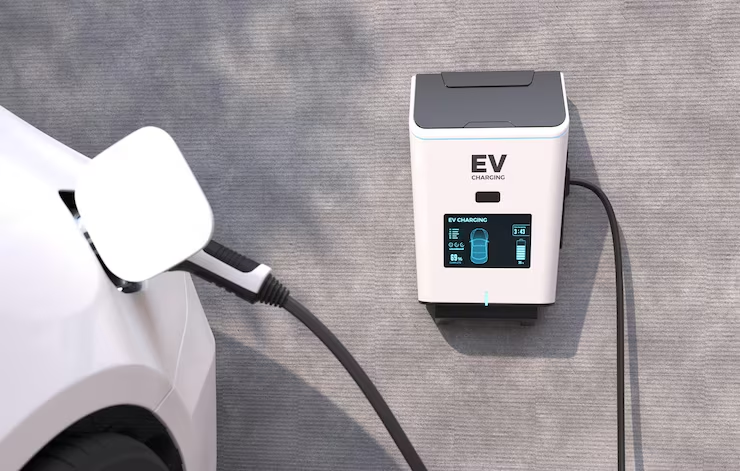
Charging Infrastructure Adds Another Copper Layer
EV affordability isn't only about the vehicle itself. The broader ecosystem matters—and charging infrastructure is deeply copper-intensive.
Each charging station requires:
- Heavy-gauge copper cabling for power delivery
- Transformers with copper windings
- Power electronics and control systems
- Grid connection upgrades (often copper-intensive)

India's Structural Disadvantage
India imports roughly 70% of its refined copper, creating three fundamental challenges:

- They are inherently material-intensive machines
- Copper is structurally scarce on a global scale
- Supply chains are globally constrained with long lead times
- India has limited domestic supply and high import dependency
Prices may soften at the margin as manufacturing scales and battery chemistry improves, but EV affordability will improve gradually, not rapidly. Structural material costs will remain a persistent headwind.
Understanding this reality helps consumers make informed purchasing decisions, enables investors to set realistic expectations, and allows policymakers to design effective support mechanisms for India's EV transition.
SwapTheMarkets | Market Analysis & Economic Insights
© 2026 SwapTheMarkets. All rights reserved.