
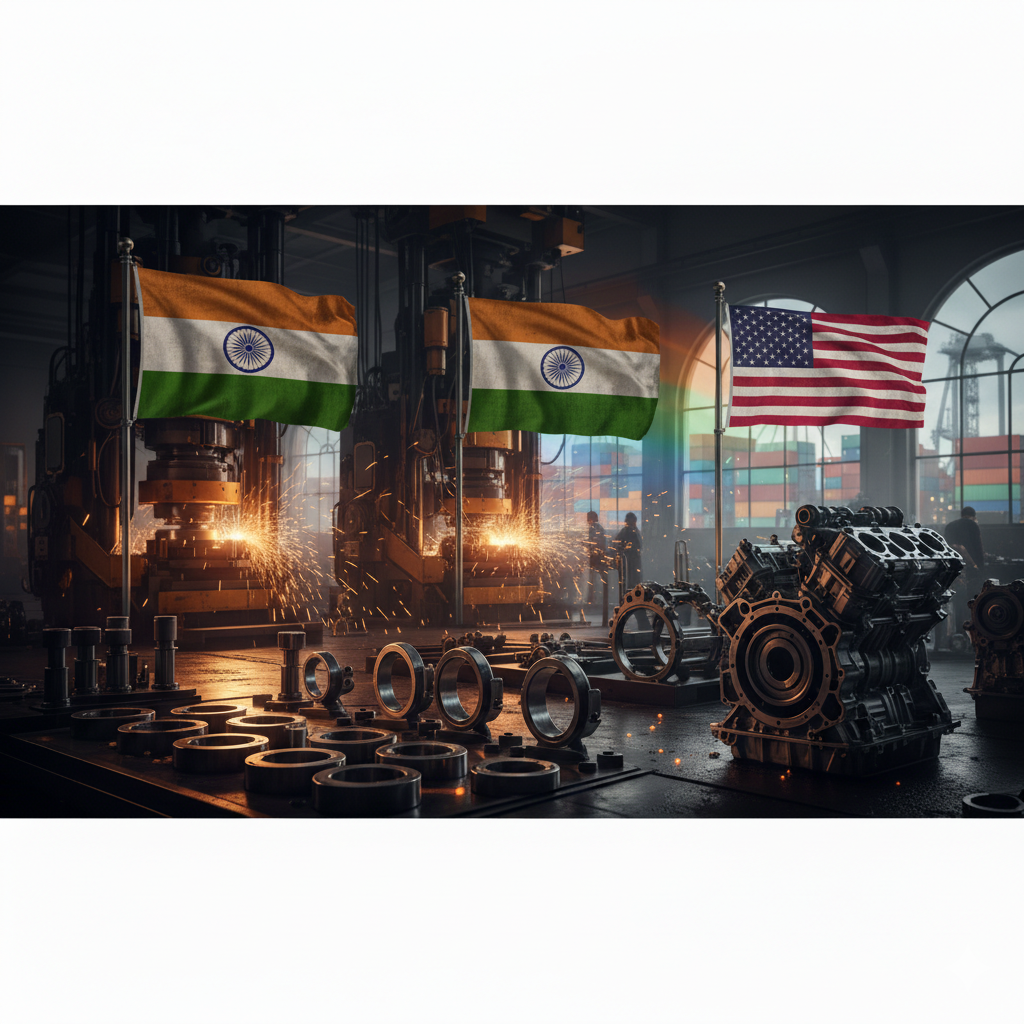
US Just Cut Tariffs on Indian Auto Parts: Why This Changes Everything for India's Export Story
By PrincipaCore | February 2026 Reading Time: 8 minutes
If you've never thought much about auto parts exports, you might be surprised to learn that the United States is the single largest buyer of Indian automotive components—accounting for nearly 27% of the sector's total overseas sales. And in a move that could reshape India's manufacturing export trajectory, the US has just sharply reduced tariffs on Indian auto parts under a newly negotiated trade framework.
This isn't abstract trade policy. This is a structural shift with direct implications for factory orders, job creation, and the earnings outlook for India's auto component industry. Here's what actually changed, why it matters, and what it means for the companies at the center of this story.
What Just Happened: The Tariff Reset
For years, Indian auto component suppliers faced a punishing tariff structure in the US market. Section 232 tariffs imposed 25% duties on certain imports, ostensibly on national security grounds. On top of that, reciprocal tariffs introduced during the Trump administration pushed effective duties on some Indian parts as high as 50%. The result was straightforward: Indian suppliers became structurally less competitive than rivals in Vietnam, Thailand, and especially Mexico, which enjoyed zero-duty access under the USMCA trade agreement.
That competitive disadvantage made it difficult for Indian manufacturers to secure long-term supply contracts with major US automakers and tier-one suppliers. Even when Indian companies offered superior quality or engineering capability, the landed cost after tariffs made them a riskier choice than alternatives with cleaner duty structures.
Under the new India-US trade framework, that equation has changed dramatically. Approximately 50% of Indian auto part exports to the US will now enter duty-free. Most of the remaining trade will face tariffs around 18%—still not zero, but a significant improvement from the 25-50% range that previously applied. For an industry where margins are measured in basis points and global competition is razor-thin, this is a meaningful competitiveness reset.
Why This Is Bigger Than It Sounds
The US market isn't a niche for Indian auto parts—it's the anchor. Indian automotive component exports to the US are valued at approximately $6.5-7 billion annually, representing roughly 27% of the industry's total export revenue. Auto exports, in turn, account for nearly 30% of the sector's overall revenue base. This means the tariff cut doesn't affect some peripheral segment of the business. It affects the core export engine that drives growth for the entire industry.
The earlier tariff structure wasn't just a cost—it was eroding margins, limiting pricing power, and constraining the ability of Indian suppliers to invest in capacity expansion or R&D. When you're competing for multi-year contracts with global OEMs, a 25% tariff disadvantage isn't something you can absorb indefinitely. It forces you to either cut margins to the bone or lose the contract entirely.
Now, with half the trade entering duty-free and the rest facing significantly lower rates, Indian suppliers can compete on merit—engineering capability, delivery timelines, quality standards—rather than being disqualified on cost before the conversation even starts. That shift matters because it changes the strategic calculus for both Indian exporters and their US buyers.
Who Actually Benefits: The Companies Behind the Numbers
Not all auto parts are created equal, and the tariff relief doesn't apply uniformly. The biggest beneficiaries are likely to be companies operating in high-value, engineering-intensive segments—engine and transmission components, castings and forgings, suspension and braking systems, precision-engineered fasteners, and tyre manufacturing. These aren't commodity products assembled with low-skill labor. They're capital-intensive, technology-driven exports that require significant expertise to produce at scale.
Companies like Bharat Forge, Motherson, Uno Minda, and Sundram Fasteners are well-positioned to capitalize on the improved tariff structure. Bharat Forge, for example, has deep exposure to engine and drivetrain components—segments where tariff relief directly improves competitiveness.
1These companies were already identified as key players in India's auto component ecosystem due to their export diversification and engineering capability. For a detailed breakdown of why ancillaries like Bharat Forge and Motherson represent better long-term opportunities than OEMs, read our analysis on Best Auto Stocks to Look Out in 2026. Motherson's integrated wiring harness and module business already has strong US customer relationships; lower tariffs make those relationships more profitable and easier to expand. Tyre manufacturers with US exposure, including some of the larger domestic players, stand to benefit as well.
The impact isn't just theoretical. Better tariff positioning translates to improved order visibility, which in turn supports capacity expansion decisions. For an industry where capital allocation is constrained by demand certainty, that visibility is the difference between greenfield investment and cautious wait-and-see.
Can Indian Auto Exports to the US Actually Double?
Industry estimates suggest that Indian auto component exports to the US could double over the next four to five years under favorable conditions. The math is straightforward: growing from roughly $7 billion today to $14 billion would require annualized growth in the 15-18% range. Is that realistic?
Second, sustained China+1 diversification. US automakers and tier-one suppliers are actively shifting sourcing away from China, driven by the same forces reshaping India's electronics and semiconductor manufacturing. Apple's decision to move all US-bound iPhone production to India by 2026 is the clearest signal of this permanent supply chain realignment—a trend we analyzed in depth in India's $1 Trillion Digital Economy. US automakers and tier-one suppliers are actively shifting sourcing away from China, but that shift isn't automatic. Indian companies need to prove they can scale capacity, meet quality standards, and deliver on time. Third, domestic investment in technology and manufacturing infrastructure. The tariff cut creates the opportunity, but execution determines the outcome.
If those conditions align, the upside case is credible. Exports could indeed double, supporting mid-teens revenue growth for the component sector and creating tens of thousands of jobs in precision manufacturing and engineering roles. But this is a structural opportunity that requires disciplined execution, not a guaranteed windfall.
Why This Matters Beyond Auto Parts
The tariff cut on auto components isn't just a story about cars. It's a signal about where India stands in the global trade realignment happening right now. For the past several years, talk of supply chain diversification away from China has been exactly that—talk. This deal shows that diversification is starting to translate into concrete policy changes that benefit Indian manufacturers.
More broadly, it demonstrates that India is negotiating better trade positioning with its largest export markets. That matters for sectors beyond automotive. If similar frameworks can be extended to electronics, pharmaceuticals, or textiles, the cumulative impact on India's export growth could be substantial.
The tariff reduction on auto parts is part of a broader structural shift in global manufacturing that's driving India toward a $1 trillion digital economy by 2030. Electronics manufacturing is growing at 32% CAGR, and PLI schemes across sectors are creating multi-year tailwinds. For context on how these trends connect, read India's $1 Trillion Digital Economy: The Historic Convergence. It also reinforces the China+1 narrative as a real structural trend rather than speculative optimism.
From a market perspective, this is how global policy directly affects corporate earnings. Tariff relief doesn't just improve competitiveness—it re-rates the earnings outlook for export-heavy companies, which in turn influences valuations. For investors trying to understand why certain auto component stocks might outperform despite subdued domestic demand, the export tailwind created by this deal is a critical piece of the puzzle.
The Risks That Remain
None of this is risk-free, and it's important to acknowledge the uncertainties that still exist. The exact parameters of the tariff-rate quota (TRQ) system haven't been fully disclosed yet. If quota limits are set too conservatively, they could cap the upside before it's realized. Section 232 tariff implementation details are still being finalized, and ambiguity around enforcement could create compliance headaches for exporters.
More fundamentally, US trade policy remains politically sensitive. What gets negotiated today can be revised tomorrow depending on the administration in power and the mood in Congress. The possibility of future tariff increases—or new non-tariff barriers—can't be ruled out entirely. And even after the tariff relief, US buyers are still paying roughly 16% more than they were before the original tariff escalations began. This is a significant improvement, but it's not a full return to pre-tariff baseline competitiveness.
The Bottom Line
Before this deal, India had a structural disadvantage in the US auto parts market. After this deal, India is competitive with Vietnam and Thailand—and in many cases, better positioned due to engineering depth and established relationships with global OEMs.
This isn't a short-term stimulus. It's a structural improvement in India's export competitiveness that should support sustained growth over the medium term. The base case is that US-bound auto exports grow in the low-to-mid teens annually. The upside case is that they double within four to five years if capacity expansion keeps pace with demand. The downside risk is policy reversal or quota constraints that limit the practical benefit of the tariff cut.
For now, though, this is unambiguously positive. It improves long-term supply contract visibility, restores confidence in Indian vendors among US buyers, and creates a credible pathway to export CAGR in the low double digits. That's a structural tailwind that should show up in earnings over the next several quarters—and in the stock prices of the companies best positioned to capture it.
Related Analysis
Auto Sector Deep Dives: The tariff relief creates tailwinds for auto component exporters, but the real investment opportunity requires understanding which companies have the quality, execution, and export diversification to capitalize. We've analyzed the top OEMs and ancillaries in Best Auto Stocks to Look Out in 2026.
India's Manufacturing Transformation: This tariff cut is part of a larger structural shift in global supply chains. India's manufacturing sector—from electronics to autos to semiconductors—is benefiting from permanent China+1 diversification. For the complete picture of how these forces are driving India toward a $1 trillion digital economy, read India's $1 Trillion Digital Economy: The Historic Convergence.
Economic Context: To understand how export growth fits into India's broader economic outlook for FY27 and beyond, see our analysis on India's Economic Outlook FY26: Why 7.3% Growth Is Just the Beginning.
Internal Links:
This tariff shift connects directly to India's broader manufacturing transformation. For context on how PLI schemes and supply chain realignment are reshaping India's industrial base, read our analysis on India's $1 Trillion Digital Economy.
The auto component sector's export growth is part of the larger premiumisation and export shift we covered in Best Auto Stocks to Look Out in 2026.
Disclaimer: This is educational content for research purposes only. Not investment advice. Consult a SEBI-registered advisor before making financial decisions.
Sources: Ministry of Commerce, ACMA (Automotive Component Manufacturers Association), US Trade Representative, Business Standard, Economic Times