
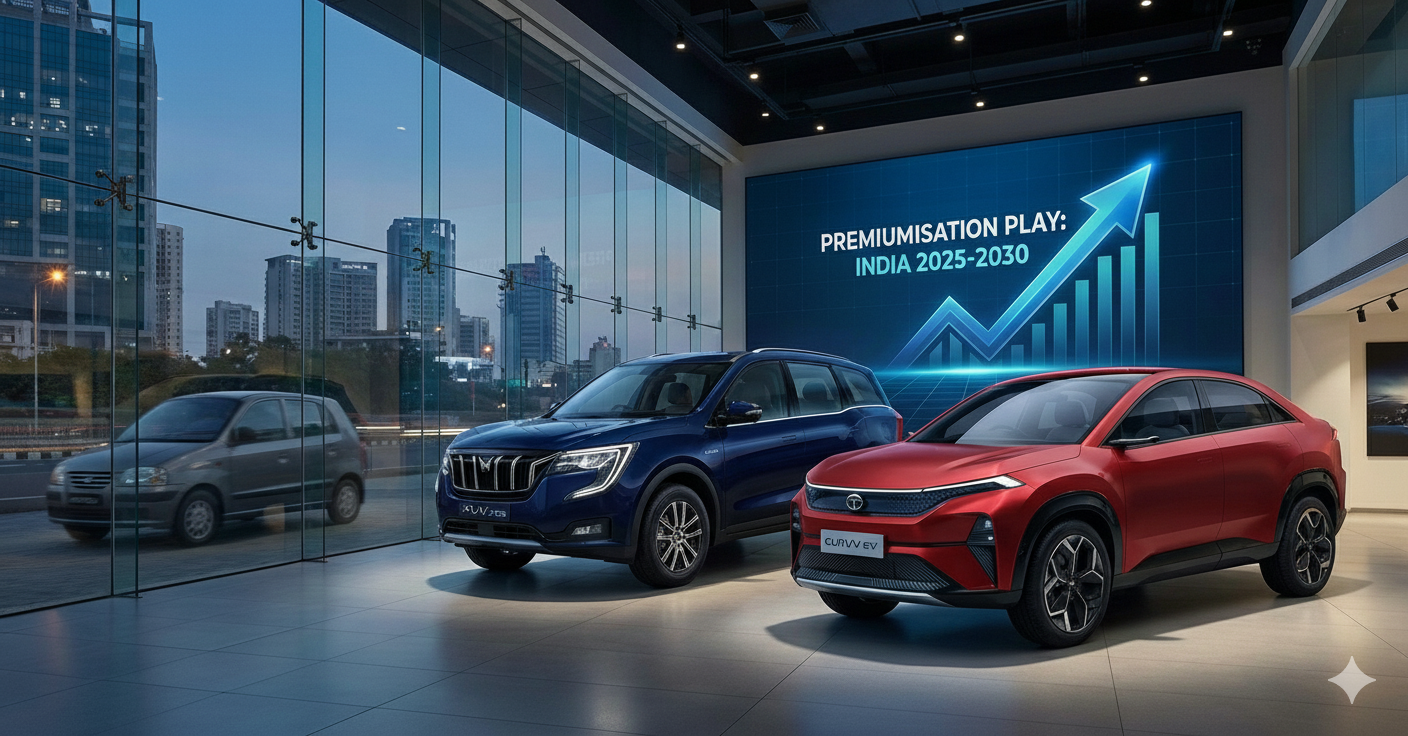
Indian Automobile Sector 2025-2030 — The Premiumisation Shift Rewriting Auto Valuations
The Thesis in 30 Seconds
India's automotive sector has undergone a permanent structural shift. For decades, the metric that mattered was units sold. In 2025-2030, it's value per vehicle sold.
Companies that understand this shift will compound wealth. Companies that don't will stagnate or decline.
Here's what changed:
- SUVs jumped from 25% to 55%+ of all passenger vehicle sales
- Premium motorcycles (125-160cc) are replacing entry-level 100cc bikes
- Feature-rich vehicles with ADAS, sunroofs, and connected tech dominate
- The profit pool is migrating from OEMs to component suppliers
If you're still buying Indian auto stocks betting on "volume growth," you're fighting yesterday's battle.
"These insights form the foundation of our stock selection framework: Best Auto Stocks to Look Out in 2026."
Part 1: The Death of India's Volume Era
For 35 Years, One Metric Dominated: Units Sold
Maruti Suzuki was the king because it sold the most cars. Hero MotoCorp led two-wheelers because it moved the most bikes. The playbook was simple:
Sell cheaper → Sell more → Win market share
That era ended around 2022.
Today's market rewards a completely different archetype:
- Companies that sell fewer vehicles but earn vastly more per vehicle
- Suppliers that export high-value components globally
- OEMs that blend ICE + Hybrid + EV pragmatically (not ideologically)
The Three-Layer Structural Shift
Layer 1: Demand Transformation — Premium Wins
The most visible change is what Indians are choosing to buy:
The Data:
- SUV penetration: 25% (2018) → 55%+ (2025)
- Premium motorcycles (125-160cc) cannibalizing entry-level 100cc bikes
- Feature-rich vehicles with ADAS, sunroofs, connected tech dominating launches
- Tata Nexon (₹8-14L SUV) outsells Tata Tiago (₹5-7L hatchback) by 3:1 despite 70% higher price
[chart:22]
This isn't cyclical. It's structural because:
- Rising incomes — India's middle class is growing; aspirational buyers prefer "premium at a stretch"
- EMI affordability — Finance availability has improved dramatically
- Resale confidence — Used SUV markets are booming; buyers recover capital better
Investment Implication:
OEMs heavy on SUVs (Mahindra, Tata Motors) outperform legacy players still clinging to hatchbacks (older Maruti lines).
Layer 2: Technology Shift — Value Per Vehicle Exploding
Even if volumes flatline, profit pools expand because revenue per vehicle is skyrocketing.
Every new vehicle sold now carries:
- EV premium: ₹2-3L extra (battery, electric drivetrain)
- ADAS (Advanced Driver Assistance Systems): ₹50,000-₹1L
- Connected car tech: ₹30,000-70,000 (OTA updates, cloud services)
- Software licensing: Recurring revenue streams
In other words, a car is becoming a rolling electronics + software platform, not just metal and fuel.
Even with 0% volume growth, margins can expand 10-15% year-over-year.
"EV adoption will be slower than expected, creating opportunities in hybrids and premium ICE: Why Only 15% Will Go Electric."
Layer 3: Profit Pool Shift — Auto Ancillaries Become the Real Winner
Here's the uncomfortable truth: OEM profit margins are being squeezed. Component supplier margins are soaring.
Why? Because premiumisation and electrification require specialized, complex parts:
- EV motors and controllers
- Battery management systems
- ADAS sensors and chips
- Software-defined vehicle architectures
- Premium electronics and connectivity modules
One auto ancillary like Sona BLW makes EV drivetrains for:
- Mahindra (100,000 units/year)
- Tata (80,000 units/year)
- Maruti (50,000 units/year)
- Global exports (200,000 units/year)
- Total: ₹1,000+ crores in annual revenue from one component
This is why auto ancillaries deserve 25-35x P/E, while OEMs sit at 15-20x.
Part 2: Current Market Reality (FY24-FY25)
Passenger Vehicles: Mix Correction, Not Demand Collapse
| MetricReality | |
| Volumes | Flat to +2% (FY25) |
| Inventory | 80-85 days (discount-driven) |
| Value Growth | Strong (SUV mix + features) |
| Structural Trend | Hatchbacks declining permanently |
Key Point: This is NOT a demand meltdown. It's a digestion phase after three record years (FY21-FY23).
Investor Implication:
- Companies fixated on entry hatchbacks will structurally underperform
- OEMs with SUV-heavy portfolios gain both margin and mix advantage
Two-Wheelers: The Underestimated Recovery
Bullish Drivers:
- Rural cash flow recovery (good monsoons, MSP hikes)
- NBFC lending normalising
- Shift from 100cc → 125-160cc bikes (premiumisation even in 2W)
EV Reality Check:
- High EV penetration in scooters (urban, short-range use)
- But ICE motorcycles (125-160cc) will dominate profits till FY28+
- Hero MotoCorp, Bajaj Auto benefit from premium bike shift
Investment Play: Two-wheeler OEMs are currently undervalued. Consensus assumes EV disruption faster than reality.
Three-Wheelers: The Silent EV Winner
Three-wheelers are the EV poster child:
- Clear TCO advantage vs. CNG
- No subsidy dependence anymore (economics work standalone)
- Fleet buyers (Uber, Rapido, logistics) adopt fastest
This segment is funding EV learning curves for OEMs. Margins here are improving, not eroding.
Part 3: Why This Shift is Permanent (Not Cyclical)
Reason 1: Income Elasticity Breaks Upward
India's per-capita GDP crossed ₹1.8L (2024). The aspirational class (₹5-15L annual income) is now the growth segment.
People don't trade down from SUVs once incomes rise. Demand stays at higher ASPs.
Reason 2: Used Car Market Absorbs Trade-Down Demand
Instead of competing on ₹4L hatchbacks, OEMs created used-car divisions (Maruti True Value, Tata's platform, Mahindra First Choice).
Budget buyers now buy 3-year-old ₹5L SUVs from used-car dealers, not new ₹5L hatchbacks.
India's used car market will hit ₹75,000+ crores by 2030, becoming a higher-ROE business than new cars.
Reason 3: Export Pressures Force Premiumisation
Auto component exporters like Bharat Forge and Motherson capture 40-60% revenue from Europe and USA.
Export standards (safety, emissions, materials) are inherently premium.
Indian OEMs can't ignore export regs, so premiumisation is forced, not optional.
The Investor Playbook for Part 1
What to Buy:
Premium/SUV-focused OEMs
- Mahindra & Mahindra (SUV-only strategy = margin expansion)
- Tata Motors (strong in buses + CVs + EVs)
Auto ancillaries with export exposure
- Bharat Forge (defense + forging + global reach)
- Motherson (wiring harness + electronics + 95% exports)
Defensive compounders
- Maruti Suzuki (unmatched distribution, net cash, hybrid leadership)
What to Avoid:
Volume-chasing mass-market OEMs
Budget-only segments with no premiumisation strategy
Overleveraged suppliers (D/E > 1.0)
Key Takeaway
The next five years of Indian auto investing reward companies that sell FEWER vehicles at HIGHER prices with BETTER margins.
Premiumisation isn't a trend—it's a permanent structural shift driven by rising incomes, financing availability, and export pressures.
The winners of 2015-2020 will NOT be the winners of 2025-2030. Your portfolio needs to evolve or get left behind.
What's Next?
[Part 2 — The EV Reality Check: Why Only 15-20% of Cars Will Be Electric by 2030 (And Why That's Good News)]
In Part 2, we'll shatter the consensus narrative that "EVs will dominate by 2030." Spoiler: They won't. Three-wheelers will. Two-wheelers will. But passenger vehicles? Only 15-20%. And smart money is profiting from betting against the hype.
Subscribe for Weekly Deep-Dives
Get instant access to:
- Sector deep-dives backed by data
- DCF-based stock valuations
- Portfolio strategy frameworks
👉 Subscribe to SwapTheMarkets: swapthemarkets.substack.com
📸 Follow on Instagram: @SwapTheMarkets
Disclaimer: This article is for educational and informational purposes only. It is not investment advice. Please consult a SEBI-registered advisor before making investment decisions.